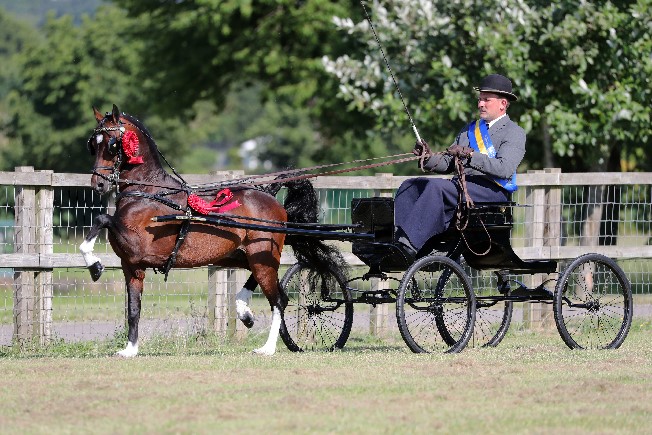
The Hackney

This article continues for members only.
To gain full access to this feature and the whole The Carriage Commentator website, please sign up
The Hackney horse and pony certainly have the ‘wow’ factor with their natural good looks, presence and high stepping trot action. In harness, they can be so spectacular they are often described as ‘The Ballerinas of the Ring.’
Show wagon classes are one of the most popular ways to exhibit the breed using four-wheeled Viceroys or Box Wagons with a single driver which maximises the the opportunity to display the paces and conformation. The lightweight vehicle design puts the focus on the horse and being free rolling, they allow the horse to be most expressive in their movement.
In Private Driving, Hackneys are also eye-catching and are often highly placed due to their quality and elegance. Coupled with a beautiful, traditional carriage, a well presented Hackney in gleaming show harness, can excite interest from spectators and judges alike. Over the years, Hackney turnouts have an outstanding record of winning at HOYS and many Private Driving championships.
The British Hackney horse is described as a ‘warmblood’ and is an athletic, medium sized horse, rarely exceeding 16h. It was originally developed as a road horse with the speed and stamina to pull carriages over long distances. The Hackney horse is more powerful and long striding than the smaller Hackney pony which has been bred to have pony characteristics. It is not a scaled down version of the horse, although both share the same Hackney features of strength, intelligence, alertness and the high stepping action. The pony head should be fine and carried high on an arched neck, with a fine muzzle and neat ears.
The pony breed was developed in the late 1800s by crossing the Hackney horse with small hardy breeds such as Fells and Welsh Mountain ponies, with the aim of creating the ideal pony for the show ring. If anything, the pony seems to have an even more exaggerated gait than the horse. The Hackney pony should be between stands between 12 and 14 hh and be compact, full of energy and have a ‘look at me’ attitude. As a driving animal, it has a reputation for being tenacious and fearless.
Beyond the show ring, Hackneys have speed and stamina, which means they are popular in driving trials, both indoor and out. There have been many successes for Hackneys at national and international level in driving trials.
Gold medals came for the British single horse team with two Hamewith Hackneys at the 2006 FEI Single Horse World Championship in Pratoni, Italy. Di Hayes was a member of the team and enjoyed great success with Hackney horses especially her brilliant mare ‘Mel’, Hamewith Culmellie, who won the cones phase with the only double clear. Previously, Di had the winning dressage score at the 2002 World Championship. Another team member, Ian Bertram drove Hamewith Lonach and overall, the combination took part in four Single Horse World Championships. For many years, Mel and Lonach dominated national driving trials classes.
Rounding off a bumper 2006 World Championship, the individual gold medal was won by Paul Sidwell with his Hackney Weirbank John. Paul later said that the Hackneys thrived when extra stamina was needed because the going was tough after heavy rain on the hills of Pratoni.
The Hackney is also successful under saddle and can be used for all riding activities. It is interesting to look into Hackney history to see how the breed was developed starting in the 14th-century from a ridden palfrey, referred to with the French term ‘haquenee’, which gives rise to the Hackney name. It was a breed with a comfortable gait and stamina in trot that became highly valued as a ridden horse.
The Tudor monarchy passed acts to encourage their breeding and protect them. As well as general riding activities, Hackney horses were very popular for use in light cavalry at this time. As roads improved the breed was favoured for its stamina in trot and increasingly used for carriage work with the addition of Thoroughbred bloodlines to improve their speed. The Yorkshire and Norfolk Roadsters (trotting horses) had a very strong influence on the Hackney as we know it today.
The foundation sire of the modern Hackney was ‘Original Shales’, foaled in 1760, and sired by a Norfolk Roadster mare put to an exceptional Thoroughbred stallion with Darley Arabian bloodlines. This foundation sire combined great speed with the stamina and stepping qualities of the trotter. The high stepping traits became increasingly valued and the Hackney soon became a status symbol – especially as they had a reputation for sound limbs as well as good looks. In the early 18th-century Arabian stallions had been also been introduced to add further refinement to the bloodlines as showier carriage horses were fashionable in Regency times. Hackneys also continued to be used widely as artillery horses and cavalry mounts until mechanisation took a strong hold between the wars and their numbers fell. The emphasis on breeding shifted to producing animals for showing, as well as athletic disciplines in harness and under saddle.
The Hackney Horse Society was formed in 1883 and continues to promote the horse and pony breeds. But nowadays, sadly, purebred numbers are considered critically low by the Rare Breeds Survival Trust. The Hackney is a distinctive and outstanding British breed and its fans, along with the Hackney Horse Society, are endeavouring to ensure that its numbers start to rebuild and its future is assured. One area which helps is its popularity as a cross-bred horse used to produce high performance sports horses in the ridden disciplines. British Hackneys have been widely exported to the USA and Europe to be used in breeding programmes and have influenced the Holsteiners, Gelderlanders, Dutch Warmbloods, Saddlebreds, Morgans among others.