The Tandem Bars#2

This article continues for members only.
To gain full access to this feature and the whole The Carriage Commentator website, please sign up
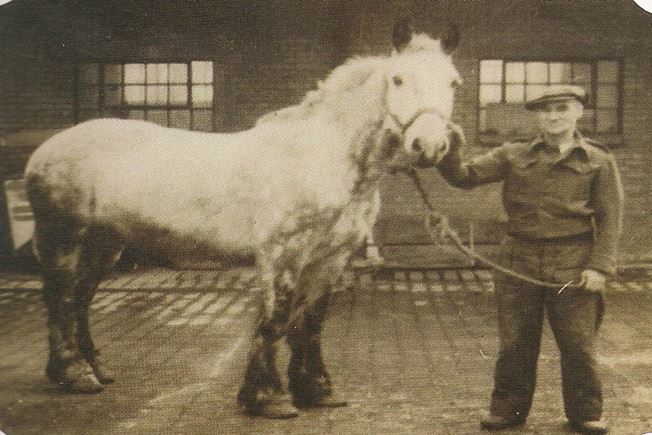
The United Dairy Vanners played an important role with the wartime deliveries of milk in Chiswick, London where I lived as a child. Milk, which was rationed in the 1940s, was left on doorsteps. The milkman would carry a few bottles in a small crate and go from house to house. Sometimes he was able to step over a low wall to get from one to another, saving having to walk the length of paths at each house. The horse would walk along quietly, keeping to the edge of the road, pulling the four-wheeled pneumatic tyred cart with was loaded with crates of glass bottled milk. The horse would stop when the milkman said ‘Whoa’ and walk on when told by a ‘Geron.’
At intervals along the route were dustbins known as ‘pig bins.’ People were told to put any little bit of food waste into these so that they could be collected and made into pig food. The Vanner became very clever at removing the lid in order to delve into the foul-smelling waste in the hope of finding an apple core or bit of cabbage stalk. Commands of ‘Geron’ were ignored at such times and the horse had to be hauled out of the bin before he could be persuaded to continue with his word.
Deliveries were made along the left-hand side of the road and the houses across the road had to wait until later in the day when the milkman was coming back. This saved an enormous amount of time and energy. The last lot of deliveries with Blackie, the horse that I first drove, were at a large block of flats and I used to help here in order to get the chance of driving the ten minutes back to the Dairy. Blackie was given his lunch at this time. A nosebag, containing chaff and a few oats, was strapped over his head, on top of his bridle. The Wilson snaffle bit remained in place so eating must have been quite difficult. Blackie kept the bag on the ground while he ate and when most of the contents had been consumed, Blackie would toss the nosebag upwards in order to release food which had become stuck in the corners.
Because milk was rationed it was easy to deliver to each flat as there were no notes left regarding requirements. Milk bottles were put into service hatches beside the front doors. There was one kind lady who used to leave a blue rimmed white enamel bowl of water in her service hatch for the horse. I can remember taking the bowl down in the lift, trying carefully not to spill the precious water. I then took off the nosebag and let Blackie drink the water. I then replaced the nosebag and returned the bowl to the service hatch. The deliveries took a long time and Blackie stood unattended. I was always thrilled that I was allowed to drive Blackie back to the Dairy.
I wanted a driving whip and so I found a stick in Chiswick Park and tied a piece of string to it. Much to my disappointment, Blackie ignored my whip. I discovered that the best way to get him to trot faster was to slap the reins on his back. This was quite effective because I expect that he was as keen to get home as I was to make him go faster. Some of the drivers were so keen to get back that they encouraged their horses to canter. It is small wonder that many of the Vanners had scarred knees caused by falls on roads.
The stalls in which their horses were accommodated were separated by two planks of wood, resembling scaffolding boards (known as swinging bales) which were hung from the ceiling by chains. If a horse was likely to kick then a third board was added below. Horses were tethered in headcollars to which a rope was attached which ran through a ring at the front of the manger and then passed through a heavy ball of wood known as a log and secured with a knot to keep it in place. This prevented legs from becoming entangled with rope. If a horse was inclined to chew the rope, then a chain was used instead.
Sunday was a day of rest for the horses, if not for the grooms who still had to come in to muck out and feed. The harness was cleaned at some time during the weekend. As far as I can remember there were about twenty horses at the Chiswick depot. I was terrified of the head groom, Dick, who no doubt did not welcome my presence at the depot in case I got kicked or hurt in any way but I was so keen to be involved and was encouraged by the younger and very kind under groom that I was tolerated. I always did my utmost to keep out of Dick’s way. Fortunately, the horses were stabled in two separate blocks of stalls, so I was able to keep clear of him. Horse food was in short supply and I can still hear Dick saying to the under groom, ‘Don’t give them ‘osses too much ‘ay!’
The under groom’s kindness was lavished on his charges when he tried to give them a bit more food. They all looked well cared for in spite of wartime shortages. After standing in on a Sunday, many of the horses suffered from ‘Monday morning leg’ with joints, particularly hind ones, filled. Some suffered from itchy heels and hind legs and would stand rubbing one hind foot against the other leg. Life was quite hard for a London working horses. There was no chance of freedom or a bit of grass.