Inspired by English collector Russell Hand, who features in our CC podcast#81 ‘The Collector’, purchasing a historically interesting Hanover State Chariot from Martin Auctioneers recently in the USA, I dusted down a file in my collection. It relates to a day trip I took to Hanover in Germany while running the Reading Carriage Sales to value and appraise four Hanovarian Royal carriages which were on display at the Historiches Museum am Hohen Ufer in Hanover. It was in April 2007 and I was pregnant with our first daughter, so I remember finding it quite an exhausting, although fascinating, day. Another aside is that I took British Midlands flights to and from Heathrow, and that once busy airline is now defunct.
The gentleman who commissioned the valuation was Herr Mauritz von Reden, secretary to the Prince of Hanover, further to an introduction from a Dr Christoph Graf Douglas who was based in Frankfurt. I spent the day at the museum with Herr von Reden and Prince Ernst of Hanover and both gentlemen were charming. I also remember having a convivial lunch with them, and being given a few spears of fresh asparagus, which wasn’t nearly enough to satisfy a pregnant lady!
The four carriages were outstanding, and it was a real treat to be able to examine one of the original Regency High Flyer Phaetons, with its dizzyingly high driver’s seat and rather perilous centre of gravity. The high values I placed on the carriages (into the millions of Euros) reflected their rarity and provenance, the buoyancy of the market at that time, and the fact that although they could be recreated if necessary, any modern versions would be pale imitations of the originals. Like the fabulous collection Richard and I saw recently in Lisbon, these carriages are important and unique works of art in their own right, and have a place in charting the social, political and artistic history of Europe, and more specifically the German and British Royal families.
In one of the introductory paragraphs, I had written, ‘Carriages such as these are complex items, involving many crafts and skills. As predominantly wooden structures, their lifespan is not infinite, but with knowledgeable care, they can be expected to last for the foreseeable future as they have been well preserved down the years.’
Looking back through my handwritten notes, obviously taken during discussions on the trip, I’d noted that George IV had sent his sons to Hanover for military training and they’d demanded that they have some carriages too. The Gold Coach was used in Hanover in 1821 during a visit by George IV, which links it to the restoration date. At some stage, family members moved to the USA as there were too many debts in Germany, and wanted to take the carriages but were not allowed to.
This was also around the time I’d been engaged to value the Lord Mayor’s Gold Coach and the Speaker’s Coach, and T & S had in the past valued the Royal Gold Coach, so I used them as precedents for the Hanover collection. It seems that one of the reasons for the valuation was the possibility that the carriages might travel abroad for exhibition purposes, and how much they should be insured for. It was a memorable project.
The four carriages were –
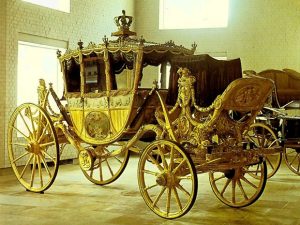 Prince of Wales George IV Gold State Coach, built in London 1783-1795.
An important State Coach, finished in gold, with decoration and embellishments pertaining to a magnificent Royal and British theme, with heraldic motifs such as the British Royal coat of arms, English lion, Scottish union, Tudor rose, St. George’s Cross and Order of the Garter Shields plus acorn and oak leaves. All the woodwork is intricately carved to the highest standards with further mythological motifs throughout such as scenes from the legend of Hercules. The doors bear oval panels with oil paintings by R Smirke showing scenes of Britannia and the waste panels are mounted with allegorical figures of cherubs. The Coach is comparable to three British gold Coaches in scale, decoration and intricacy, although was produced at a later date. It was refurbished in 1821.
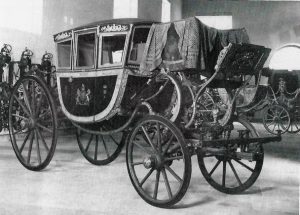 State Coach No. 2, built in 1790 by Christoph Friedrich Riess in Karlsruhe, Germany.
An important and highly decorative state carriage finished in gold, black, red and blue with motifs alluding to the connection with Great Britain and the Royal families, such as the Garter crests. It was returned from France in 1814 and refurbished in 1819 and 1833.
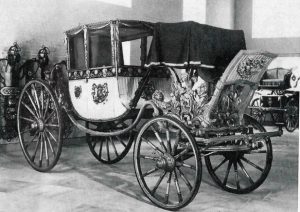 Prince of Wales George IV State Chariot, built in 1790 in London.
An important, well preserved and highly decorative state carriage finished in gold, red and blue with many motifs alluding to the connection between the British and Germany Royal families, such as the Prince of Wales feathers and Garter crests. The carriage was retained by the German government against debts owed by the Hanovarian princes.
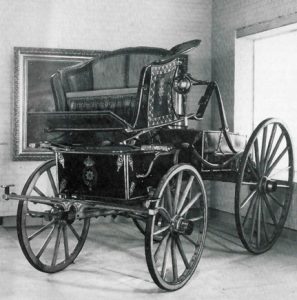 Prince Eduard’s High Flyer Phaeton, built in 1785 in London.
A rare and important carriage in excellent condition, finished in brown with yellow and light blue wheels, silvered furniture and decorated throughout with British Royal motifs.
It is similar to the Phaeton featured in the 1793 George Stubbs painting of George IV when Prince of Wales with his High Flyer Phaeton. It was sent to Hanover in 1823 for the prince’s brother, Adolphus, Duke of Cambridge.
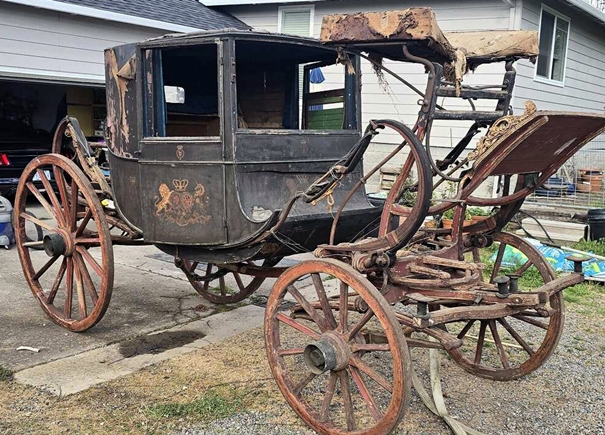
For interest, below is the information about Russell’s carriage kindly supplied by Paul and Karen Martin –
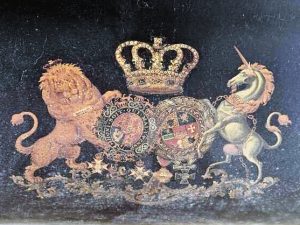 The Chariot was built by Adams and Hooper of London, whose business dates from 1805. According to the heraldic embellishments on the panels, it belonged to Ernest Augustus, 5th son of George III and younger brother of George IV and William IV, who became Queen Victoria’s uncle. He was born in June 1771 and died in November 1851. He was created the 1st Duke of Cumberland and Teviotdale, and Earl of Armagh in April 1799. In August 1815 he married his cousin, Princess Sophie Charlotte Alexandrina, the 3rd daughter of the Grand Duke of Mecklenburg-Strelitz. He succeeded to the Crown of Hanover on the death of his brother, William IV in June 1837.
On the Chariot there are British Royal crests, Order of the Garter crests and allusions to the Most Honourable Order of the Bath Military Division, plus the Hanover crown.
It was one of seven imported to America many years ago, purchased by six collectors. Martin Auctioneers first sold it in the mid-1970s in Texas when it was purchased by the late John Lapp of Intercourse, Pennsylvania. Before restoration could begin the carriage was sold to another collector in California because Mr Lapp died. It was in this family’s possession for about 35 years before being consigned by a Maryland based vendor to the 55th annual spring auction in Lebanon, Pennsylvania.
There is correspondence from Geoffrey Francis FRSA of Whatfield Avenue, Whetstone, London N20 in 1974 to John Lapp. Tom Ryder also had correspondence with Mr Lapp and facilitated the sharing of information and ‘restoration suggestions’ from Mr Francis.