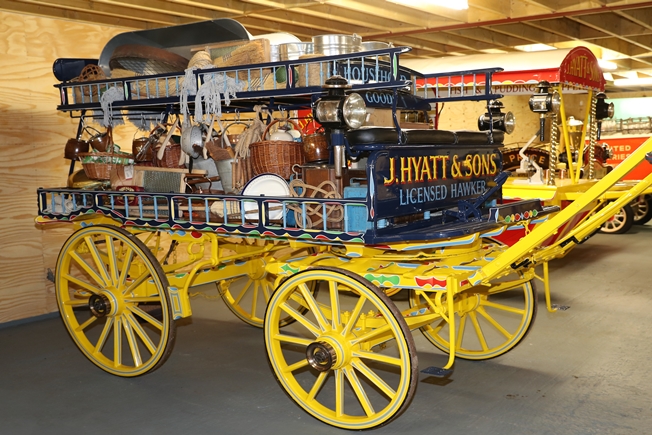
Of all the colourful and eye-catching turnouts on the trade circuit, one of the most striking is the fully laden costermonger’s trolley. Although trolleys were traditionally well represented in light trade show classes, vehicles must be shown unladen so the sight of a vibrant coster trolley with its full regalia is increasingly rare. Opportunities to see these turnouts can still be found at a handful of shows or the annual parades, but in the heyday of horse-drawn transport the costers and trolley drivers had numerous chances to show off their turnouts, often at impromptu classes held on the city streets where they worked. Kept alive by a few stalwart enthusiasts, usually with origins in the fruit and veg selling business, is the time-consuming tradition of arranging the display of fruit, veg and flowers, which at its apex can stand up to 14 feet.
The term costermonger refers to market traders and street hawkers who sold all types of fruit and vegetables, although the word’s origins stem from the sale of ‘custard’ or ‘costard’ apples which were grown around London. The costermongers and their lifestyle have long been a source of fascination, and they have been well documented in British literature, from Shakespeare to Dickens. With their notoriously dubious respect for the law, own street justice and elected community leaders, latterly the Pearly Kings and Queens, they have a strong association with horse-drawn transport, not only with trolleys but also donkeys and barrows.
Trolleys were some of the most versatile and commonly used vehicles in all areas of horse-drawn transport. There are numerous variations, but generically a trolley is on four wheels with a broad and long flat body or bed with a large carrying capacity, at a height that enables easy loading and unloading. There may or may not be seats – if there is no seat the driver perches or stands on the front, or there may be a single central seat or wider bench, set on a raised front board, perhaps flanked by upright panels with metal spindles. There is usually a small tailboard on chains, above a square locker placed under the body. If there are sides, they can be hinged or fixed, or in the form of shaped boards bearing the owner or trader’s name.
Small wooden wheels were used until the introduction of pneumatic tyres with artillery type metal centres, which made pulling and maintenance a little bit. The shafts are usually detachable and there is either a screw type or foot brake. The quality and finish obviously vary, but those seen in the show ring display a high level of craftsmanship, with ‘butterfly’ chamfers to the sides and fine lining and bright, multicoloured painting.
The coster trolley would be pulled by a ‘good’ trade type, usually a cob with a bit of Hackney blood, although in former times donkeys and mules may also have been used. Another distinctive aspect of the turnout is the flashy coster harness, with its red or yellow embellishments, horseshoe buckles, multiple metal or pierced leather keepers and extra kidney beaters.
Trolleys and coster harness continue to sell well at the Reading Carriage Sales with a good trolley making in the region of £5-8,000 and a set of harness will sell for several thousand pounds, especially if it’s by one of the traditional London makers such as Giddens or Sharlinski.
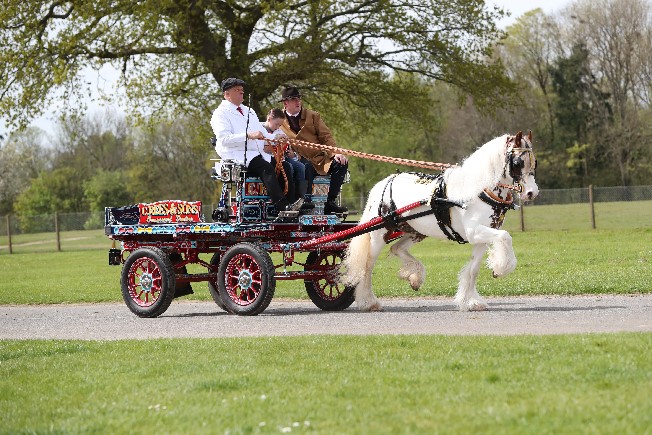
The main picture was taken at the Easter Monday harness horse parade and is produced to a high standard by the Randall family. There is superb attention to detail, including the matching sack truck which is on the seat behind the driver and his assistant. Both are wearing clean, white smocks, flat caps and matching ties. Unseen from the photo, but usual on this turnout would be a hessian nosebag and metal pail hung underneath at the back which would be used to feed and water the horse while on its daily rounds.
One of the best places to see an interesting selection of trolleys is at the annual BDS Show at Smith’s Lawn in June.
Related to the trolleys are the two-wheeled Bradford Carts which are often profusely carved and decorated, sometimes in gold, and they are much sought after.