Road Club AGM
This article continues for members only.
To gain full access to this feature and the whole The Carriage Commentator website, please sign up
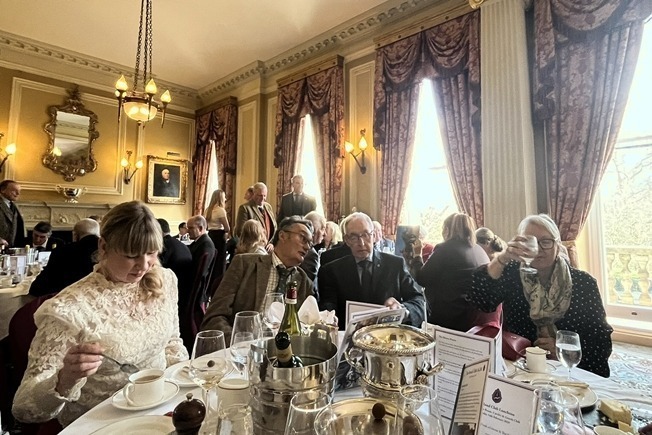
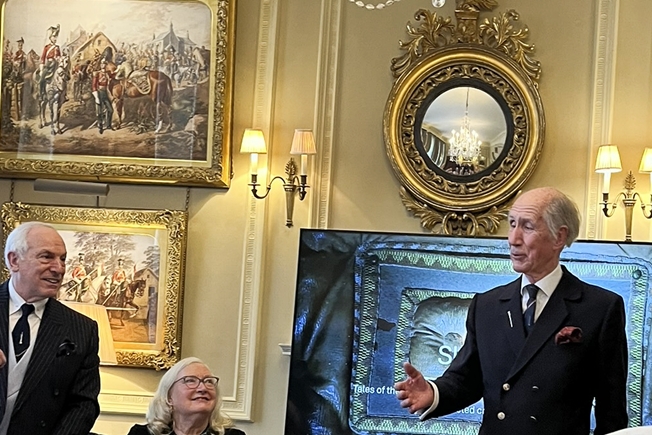
Colin Pawson was a deserving and popular recipient of the Bill Vine trophy at the Road Club annual general meeting and luncheon at The Cavalry & Guards Club in Piccadilly, London. Richard Lanni, one of the Road Club’s directors, rightly said was long overdue and expressed his surprise that Colin hadn’t been given the award before now. Not only has Colin championed the art and history of coach horn blowing, he has also organised numerous successful coaching meets and runs.
It was a welcome move that sees the Road Club returning to its roots. Since its early days, when Frank Warrender gathered like-minded coaching enthusiasts together and we all met in the atmospheric George Inn on Borough High Street, the Road Club has burgeoned. Once the George was outgrown and could no longer hold the number of members and guests who wished to attend the annual gathering in February, a new venue was found in the Cavalry & Guards Club.
Not because of the move, but partly because of the direction that club seemed to be moving, the emphasis shifted towards rather more glitzy gatherings, often abroad. The membership became more international and serviced those who liked to travel or had their own Coaches and teams, and in some ways, echoed what the Coaching Club was doing.
But with the new crop of directors – Richard Lanni, Barbara Stockton, Liz Jarman and Chris Thompson – the feet are back on the ground, and a more inclusive balance has been re-established.
Once the formalities of presenting had been presented of the annual accounts, news about future fixtures and a summary from Barbara about the past year’s activities, we settled down to enjoy three entertaining presentations.
Dutch carriage collector Fred Hollander spoke about a Private Driving Club meet in central France to be held in early July. The PDC was founded in 2000 and aimed to link driving enthusiasts in Europe and the USA. The July gathering will be held at the Chateau de Prye which is part of an estate developed by Antonin de Bourg de Bozas (1836-1922) specifically for his coaching, equestrian and sporting pursuits. He was a fascinating character who was Napoleon’s Master of the Horse and was influenced by ‘English Coaching’ standards having been taught by Edwin Fownes. He owned ‘Le Caprice’ Road Coach and was a member of the Reunion Road Club which included some of the leading American coachmen of the day.
Fred likened the estate to Badminton in Wiltshire in terms of its importance in coaching history and unique driving heritage. The stable yard was built in 1887-88 and is said to be one of the finest in Europe. The 38 stables were designed with the wellbeing of the horses at the forefront and are spacious and light, with cooling marble walls. Fred extended an invitation to Road Club members to attend, with or without turnouts, and stated that the politicians are due to meet soon and discuss relaxing some of the onerous and expensive paperwork and veterinary checks that have made travelling with horses between the UK and continental Europe so difficult in recent years. Fingers crossed.
John Hunt from the USA who described himself as a ‘Pennsylvania farmer and lawyer’ then took the floor to report on the weekend of coaching at Newport. It’s a rarefied gathering that takes place very three years. The Dutch photographers Arthur and Joyce van der Vlies had snapped many images of the turnouts and put together a film which made interesting viewing. Depending on the hour of the meet and drive, the ladies – even if they are on the box – sometimes don’t wear hats and are in evening dress, which looks incongruous to our British eyes.
Then it was the turn of an animated and interesting Amy Bracey, who runs the Carriage Foundation. Amy held our attention by talking about the whys and hows behind some of her work with museums and collections. She said that much of what’s done is to make the historic carriages relevant and relatable to the general public, and the best way of doing it is to find out as much about their history and previous owners as possible. The information then becomes a story which makes an otherwise old and inanimate object come alive.
Amy cited several carriages which had been misattributed or misdated and ended up far from their origins. By scratching surfaces and joining snippets of information, she has uncovered long forgotten provenances and, in some cases, reunited carriages with their original towns, families or properties.
One example was a carriage that turned out to have belonged to the enterprising John Baskerville from Birmingham, who was a wealthy printer and put his name to the Baskerville font. The carriage is listed in a book by Ralph Strauss but had ended up in the Nottingham Museum storage. The panels were elaborately ‘japanned’ – something else in the Baskerville business empire – and bore a resemblance to more European carriages, like those in the Lisbon Museum, in their Rococo type decoration schemes.
Working with the Hamilton Kerr Institute at the Fitzwilliam Museum which is linked to Cambridge University, dates have been ratified and the carriage has been returned to Birmingham after a circuitous history, quite like its colourful owner who is reported to have had four funerals.
Amy also talked about the quirky ‘Man Fly’ enclosed carriages which were used in 19th-centry Brighton around the Pavillion and in spa towns when transporting clients who might be often wet and not fully clothed. Pulled by servants (!), it would be more expensive if there was a heavier client inside because they’d need another servant to push as well. Evidently, although taken up by the Prince Regent of the time, they were invented by a builder who had been injured and needed to be transported between his projects.
She ended with the news that a new Science & Innovation centre had been set up in Wroughton near Swindon in Wiltshire. The site of the vast Science Museum storage hangers, they are now open to the public and well worth a visit.