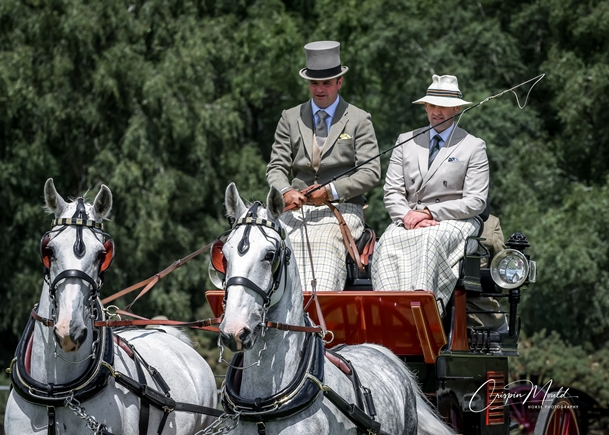
The Tandem Bars#1
This article continues for members only.
To gain full access to this feature and the whole The Carriage Commentator website, please sign up
When I was invited by Sarah and Minta to write for The Carriage Commentator, I was flattered and delighted to accept. The next thing was to decide on what to write. It soon became obvious that it would be best to start at the beginning, which was my childhood in the 1940s, in London when working horses were still a common sight on the streets.
Coal was brought to our house on a large four-wheeled dray which was pulled by a Shire type horse with a moustache. I remember the smell of sweaty horse and coal, which I savoured as a nine-year-old child. The dust cart was similar but had a series of curved lids which were pushed up so that the dustbin could be emptied and then closed down again. The smell was horrendous. A similar large horse pulled this load.
These working horses stood patiently whilst the work was done by the man. The laundry van, which came once a week to collect the dirty laundry that was put into a large wicker basket, and bring back last week’s laundry, now clean, was pulled by a beautiful chestnut horse, on the lines of a small hunter. Great pride was taken with this turnout and there was evidence of past successes at the Van Horse Parade which was held every year in Regent’s Park in order to encourage good welfare for the working horses of London. Awards were given to those reaching the required standard, in the shape of merit badges, which were then proudly fixed along the shafts for all to admire.
The greengrocer drove a roan cobby pony to his four-wheeled trolley which was loaded with fruit and vegetables. Something must have happened to the roan because that was replaced by a fast trotting Hackney pony who went along, as quickly as he was allowed, with his head turned to the left most of the time. His driver lived in a house near to ours and I often saw the pony standing quietly, with a leather trimmed hessian nosebag strapped over his bridle, complete with bit, eating his lunch, while the driver went into the house for his. It is possible that a chain was put through a wheel and fixed to the cart to act as a kind of brake.
The coster carts were usually pulled by smart Cobs wearing colourful coster harness. The buckles were frequently horseshoe shaped. There was often colourful trimming to the collars and saddle pads. Kidney beaters, trimmed with colour, were fixed to the crupper back strap. In general, kidney beaters were not worn by any of the other trade horses. A webbing halter was usually put on, under the bridle, enabling the horse to be tethered if necessary. The costers were very proud of their horses and they were tuned out with great pride.
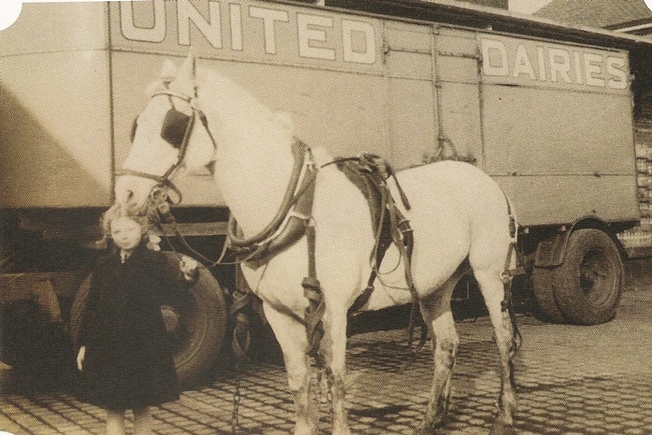
The milkman’s horse, which came to our house six days a week (there were no deliveries on Sundays), was the first horse which I drove and proved to have a great influence on my life. He was a black cobby type, approximately 15 hh, known as a Vanner. He had a hogged mane and his tail was cut off below the dock. Fortunately, he was not docked. In the winter he was trace clipped and if the weather was bad, he wore a waterproof quarter sheet. A number was burned into one hoof when he was shod. He was known, at the United Dairy, by this number which was also on his collar and on a metal plate on the wall above his head in his stall at the dairy.
His harness was black leather with white metal furniture. The buckles on the girth and belly band only existed on the near side. The saddle and collar were serge lined. The traces were fixed by a ring at the hames end and adjusted for length by a chain at the end to join to the trace hooks on the cart. The bridle had a wilson snaffle and usually a non-operative noseband, which merely held the cheek pieces in place. If the horse was likely to chew the reins, the ends by the bit were made from light chain. If a horse was likely to bite, then he had to wear a small muzzle in order to protect the public from getting hurt as they walked by.
I used to wait for Blackie, as he was called by the milkman, to arrive and used to go out and make a fuss of him whenever possible. Eventually, in exchange for helping to deliver milk at a large block of flats nearby, I was allowed to drive Blackie back to the dairy. When we got back to the depot, the milkman would drive the cart alongside an unloading bay where the day’s empties were dealt with. The milkman undid the bellyband, breeching straps and chain ends of the traces, which were swung round to keep them from the ground.
A slap on the quarters was the signal for Blackie to walk out of the shafts which fell from the open tugs with a clatter on the concrete. Blackie then walked to the water trough by himself and submerged the cheekpieces and reins in the water while he drank, heartily, until he was satisfied. He probably had not had a drink for hours. He then walked to his stable and to the correct stall and waited for a groom to come and take off his harness. I was allowed to take the harness off, but I could not manage the collar, because it was too heavy, so that had to be left for a groom to do.