The Chief Steward
This article continues for members only.
To gain full access to this feature and the whole The Carriage Commentator website, please sign up
What is the role of a chief steward?
Being asked to become a chief steward is one of those jobs where perhaps it’s best not to know too much about what’s involved in advance! While it is a great honour to be bestowed with the title in the equestrian world, the reality is that it’s a ‘buck stops here’ position which requires many skills – not least diplomacy, forbearance, kindness, stamina, knowledge and a good sense of humour.
It is also a role which is voluntary (unpaid), but one which does take up many hours and a lot of headspace beyond the event / class / weekend itself. Managing the event / class / weekend is usually the culmination of a year’s planning, tweaking and discussion, involving meetings, Zooms and many miles travelled.
Having an in depth understanding of the event is a given – it’s format, timetable, schedule, prizes, sponsors, lay out etc. If working at a county or equine show, there may well be an ‘office’ to rub alongside where the executive (paid) staff operate, usually under the leadership of a director or CEO. One of the most vital but delicate balances a chief steward faces is the relationship between those who work behind the scenes professionally, and those who volunteer for the event of their own volition, as well as the competitors.
Despite the weighty role, sometimes the chief steward must contend with decisions which are probably made out with their control. For instance, what classes are available and their capacity, closing dates of entry, timetabling, ring time and size, location etc. But these are matters that directly impact the chief steward and for which the competitors are likely to hold them responsible.
TEAM PLAYER
While being a chief steward entails leadership, it’s also one which requires team integration. A chief steward may inherit their stewarding team(s), some of whom may have been doing it in a certain way for a long time, and who are rather set in their ways. This might require supreme amounts of diplomacy as things do change and ways of running a class or show must move with the times. Ideally, a chief steward can put together their own team and then they know they are working with people who share the same outlook and will be willing to do their bidding when needed. Ensuring that everyone is made to feel welcome and is treated fairly, especially the competitors, is a must. Showing and competing, especially in driving, is a time consuming and relatively expensive pursuit – not least in filling up the lorry or 4 x 4 to get themselves, the horse(s) and kit there. Ensuring that a competitor has a safe but great day out, whatever their result, is another aspect of the chief steward’s job. Ensuring that everyone behaves in line with the rules, animal welfare expectations and treats those around them appropriately is also in the remit. Having to ‘have a word’, politely, fairly but sternly, is occasionally required.
JUDGES
The chief steward may well have a hand in appointing the judges, particularly in showing classes, although it is usually the show office or main organiser that invites them and organises the logistics. The relationship between the chief steward and their judge(s) is also important. It’s likely that members of the stewarding team will directly manage the class or arena, and help with time keeping, interfacing with the competitors and handing out prizes. Meanwhile the chief steward has to maintain an overview and check in every so often with the judges, commentators or sponsors, and keep ‘jollying’ everyone along. One thing they do not do is judge the class or have an open opinion about the results – that’s best saved for private, if at all.
ROYAL WINDSOR
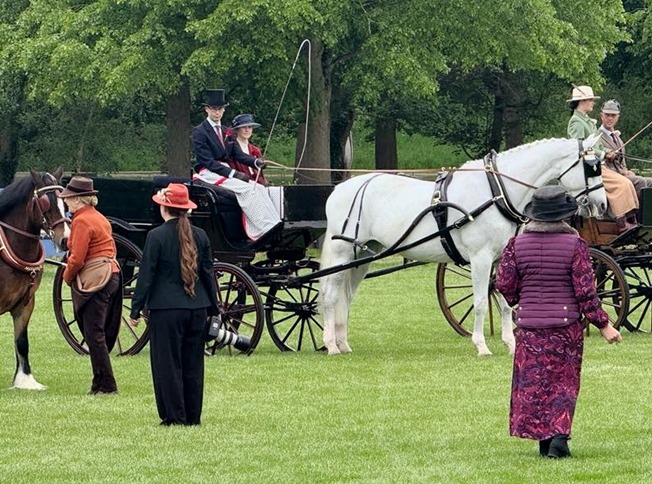
The chief driving steward role at the Royal Windsor Horse Show is one that requires a year-round commitment and considerable firefighting. The job is separate from the FEI Driving Grand Prix – up to a point. Both the driving trials and the ‘traditional’ side have to be mindful of each other, especially for the Coaching Marathon on the Friday when the procession of coaches passes the FEI Dressage arena, at least once, and then again during the BDS Meet when up to 30 turnouts are on the Concours d’Elegance Drive while the FEI Cones is going on.
But that’s just the tip of the iceberg. Immediately after each show, a detailed report is submitted to the show directors, often with a list of tweaks and requests for next year. Then judges for the following year are suggested. Around November time, the wording for the schedule is ratified with the office. Then it goes quiet for a bit whilst the Horse Power team run the London and Hong Kong shows, before it’s all systems go when the entries are opened. Keeping abreast of entry numbers while drumming up support for the classes is something that happens too, alongside keeping the stewarding team in the loop via one of several WhatApp groups. Helping answer competitors’ queries, especially if they are coming from overseas and sourcing stabling, is another aside.
About a month before the show, a site visit is made to Home Park and the routes are ratified for the Coaching and BDS Meet. Each year there’s a different challenge or obstruction, due to security issues or extenuating circumstances, and the routes must be submitted to several people including the police, Royal security and park management, for clearance. A health and safety document is also produced that must be signed off.
The countdown to the show itself is one of the most exciting times. The fluffy bit is deciding which outfits and hats to wear, although the reality is that many changes of clothes will be required, and warm and wet-weather gear may well be needed. Although in 2025 we needed cooling, wide brimmed hats and sun lotion more than wellies!
In the run up to the show, the WhatsApp stewards and competitors chats are busy with queries and instructions. Judges are contacted and prizes are confirmed. Sometimes rather obscure requests come from the show office, like dealing with German film crews, or suggesting relevant subjects for the show programme, or, like this year, discussing show fashions and style with a journalist about what’s involved in deciding what to wear on a carriage.
The heavy lifting starts the week of the show. The pressures on the management team at Windsor are different from any other show due to the venue and the proximity to more than one Royal family. There are meetings each morning where all the department heads gather and discuss the day ahead or any issues from the previous day. This is always fascinating.
For the driving, issues such as last minute route changes due to swathes of metal tracking that have suddenly appeared on the internal roads, or a new security brief, or the designated parking areas being too full or muddy to accommodate the driving competitors, or having to change the route to the showing arenas, or getting the arenas rolled etc. mean that it’s a constant juggling act and communication lines are always open, 24/7.
Ordering the courtesy cars for judges and officials, sign posting the drives in Home Park and routes to the arenas, liaising with the FEI stewards plus the police, security guards on the gates and operations managers before the drives; organising the welfare stops and the drinks for the Coaching, ensuring there is water en route for the horses, and ensuring the security gates will open on time whilst keeping everyone happy, motivated and positive, well briefed and feeling valued… means that behind the scenes, there are late nights and early mornings, a constantly vibrating mobile phone and buzzing walkie talkie.
The aim is to keep everyone safe but to make it fun. The driving stewarding team at Royal Windsor is made up of people who are mainly self-employed so in dedicating their week to running the showing and coaching classes, they are scarifying their income. We don’t do it for personal gain or reward; we do it because we are passionate about driving and we want to retain our presence at the show while promoting good practice and high standards.
In fact, we have a great time because we are friends who work well together and we never take for granted how lucky we are to spend our days in the shadow of the great castle at one of the greatest outdoor events in the world, whatever the weather may bring!