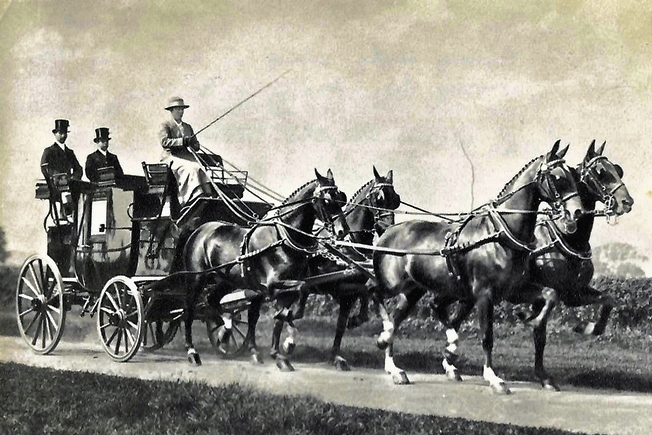
Sylvia Brocklebank Part 1
This article continues for members only.
To gain full access to this feature and the whole The Carriage Commentator website, please sign up
The accident of birth shapes us all but being born into a wealthy family is a bonus if you wish to drive a coach and four. But dedication, talent and hard work are also prerequisites, as well as deep pockets, and fortunately for Agnes Sylvia Brocklebank, she had them all. Born in 1882 to a family of shipbuilders and Victorian industrialists, Sylvia was one of six siblings and had a twin sister Evelyn Violet. She never married and was known as ‘Miss Brocklebank’ or, to the family, ‘Daisy’.
Sylvia Brocklebank assumes one of the top spots in driving’s global hall of fame. She is an iconic figure who during her lifetime was a respected and skilled whip, yet as a woman, also broke down barriers. That she did what she did so well as a woman, largely in a man’s sphere, during an era when females were often subordinated to men, is fascinating and adds to her legendary status. She was at the height of her coaching powers at the same time as the Suffrage movement, yet nothing in her diaries, so beautifully encapsulated by Tom Ryder in the book ‘The Road and the Ring’, hints at anything other than an acceptance of the status quo of Edwardian England. Although noted for her kindness and humility, she was nonetheless a formidable character who was a particularly talented horsewoman, and a committed and determined coach(wo)man. She remains a hero to many of us, not least one of our own living coaching legends, Caroline Dale-Leech.
I have a personal insight into her character, not because we met – sadly – but because we are related. She a cousin of sorts, on my father’s side of the family. In her diaries, on several occasions she mentions her cousin Sybil Needham (my maiden name) who was my great, great aunt. Sybil was about the same age as Sylvia and was one of her regular coaching companions. Great Aunt Syb, as she was known in my family, helped raise my father after Syb’s nephew, my grandfather, was killed in World War II. She paid for my father’s education and Dad would spend his holidays at her estate in Budleigh Salterton in Devon. He adored his Aunt Syb, who had been head girl at Cheltenham Ladies College. Syb was also highly astute financially and had her Times newspaper ironed for her each morning by the butler. That she and Sylvia were close companions indicates that they were kindred spirits, two determined and capable ladies who seemed, through 21st-century eyes, to baulk at the societal convention of their class and times. Syb’s connection with my father was made all the stronger by the death of her brother, Dad’s grandfather Ronald, who died in the Spanish flu pandemic. Ronald had worked for the Westinghouse family in the USA, into which Sylvia’s twin Violet married, and he is also mentioned in the Road and the Ring, so we know he was another coaching companion.
We can’t know how Sylvia or Sybil felt about their positions in society, or its structure, but they both seemed to embrace it yet do what they were willed to do, despite convention. Dad says that Syb was strict about not discussing politics or money, finding them ‘vulgar’, but she did talk about her coaching days. How ironic it was that although Sylvia could not herself vote in an election, she recounts how in 1910 she ‘drove to the poll’ with her coach to support three Conservative parliamentary candidates. At that time, polling took several days, and Sylvia was doing her bit to encourage those who could vote – the men – to do so. But one can’t help feeling that Sylvia would use anything, such as going to a polling station, as an excuse to organise a jaunt with her coach and four and put together a party of friends to share and enjoy the outing.
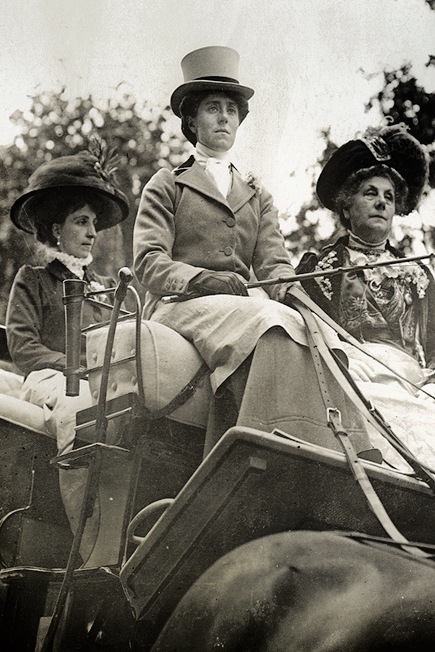
Much of Sylvia’s redoubtable character seems to have been shaped by her mother Agnes, who was a frequent companion on her daughter’s coaching trips. Of the two, and at a time when these things seemed to matter so much, it was stated that Violet was ‘the beauty’ – which must have aided her good marriage into the American Westinghouse dynasty – and Sylvia, although not a beauty, was good fun. The sisters were both excellent shots, a pastime which was encouraged by their father, and they pursued it when not coaching. They were also proficient artists, and on their coaching trips sometimes sketched during rest times.
In what must have been a bid to round off their development, Agnes sent her twin daughters to finishing school in Paris when they were sixteen, something which was conventional for a family such as theirs: what was far less conventional was Agnes, who had read about the famous coachman Edwin Howlett, sending her daughters to him for lessons.
Howlett was an Englishman who had set up a four-in-hand school in Paris, where he gave lessons mainly to wealthy Americans. He also famously ran the ‘Magnet’ Road Coach between Paris and Versailles. Although Edwin was born in Paris, his father was originally from Norfolk and had been coachman to the Marquis of Hertford at his Parisian base, which must have been what took the family to France. The young Edwin, who was also an accomplished linguist, had shown an early mastery of the ribbons and aged seventeen, had driven a coach with only the one team all the way from Vienna to Paris, completing the journey in just under eight weeks. To this day, he is heralded as one of the master practitioners of the art of four-in-hand driving and his influence continues to spread far and wide, not only through the legacy of his many pupils – alumni including Vanderbilt, Fairman Rogers and Achenbach – but also his five sons who stayed in the profession and forged their own excellent reputations.
In her diaries Sylvia reports that she and Howlett formed an instant rapport, and she attributes much of her coaching success to his teaching. Equally, he records her as one of his star pupils and they remained in correspondence until his death in 1910. She obviously displayed natural talent as well as enthusiasm, and she appeared to relish Howlett’s use of the narrow Parisian streets and alleys for his teaching. One of his lessons involved making his pupils reverse a coach into confined spaces and alleyways. This was something Sylvia continued to do, and she prided herself on her successful negotiation of seemingly impossible ‘boltholes’ which would amaze onlookers. Having had three lessons a week for three terms, Sylvia stated this was her favourite part of her time in Paris and when she returned to England, she put her learning to good use with the family’s carriage horses and a shooting break.
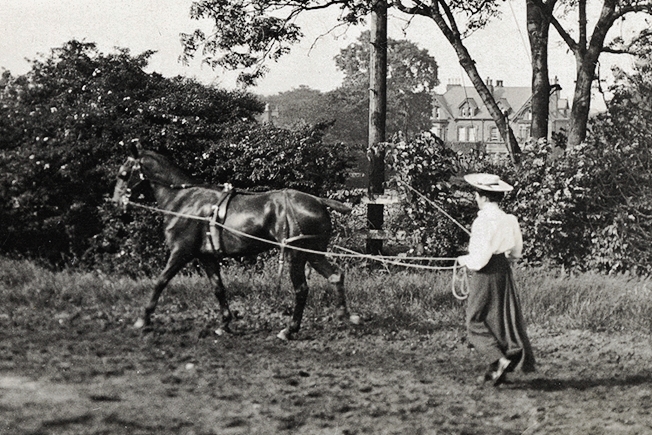
‘The Road and the Ring’ in unequivocal about Sylvia’s passion for all things connected with coaching, driving and the carriage horse. In addition to her own endeavours on the box, she would travel far and wide to take a seat on someone else’s coach, inevitably having a strong opinion of the skills (or lack of them) of the whip and quality of the horses. While clearly a capable whip in her own right, she would accept with apparent humility the offer of driving another team and thrived on the experience. She regaled her stories with good humour and modesty, whatever the situation, and seemed to be completely unflappable when faced with a tricky animal, particularly enjoying the challenge of putting a young team together or overcoming a pulling horse.
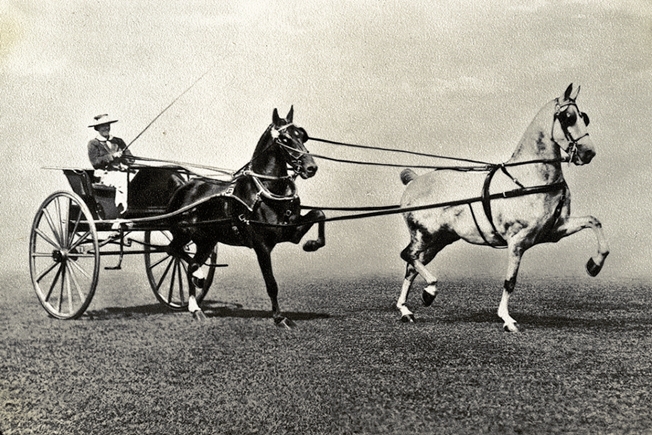
The book begins in 1905 when Sylvia was 23 and is based on her own diaries. Each chapter covers a year of her activities, until the final chapter which summarises 1914 onwards. By then, the world was a changed place and so much was curtailed by the Great War. The book chronicles her many coach trips, her endeavours in the show ring – particularly at the new international horse show at Olympia in London – and latterly, her tremendous success with the tandem, Optimistic and Illusion. Illustrated throughout with photographs of not only Sylvia’s horses and carriages, but her many coaching friends and associates, it shows an impressive array of superb turnouts at the zenith of the early 20th-century coaching revival, 100 years ago. Throughout the book, we are reminded of the enthusiasm and support of the entire family in Sylvia’s coaching endeavours, from accompanying her on trips to sharing the cost of hiring horses or a coach.