The Tandem Bars#3
This article continues for members only.
To gain full access to this feature and the whole The Carriage Commentator website, please sign up
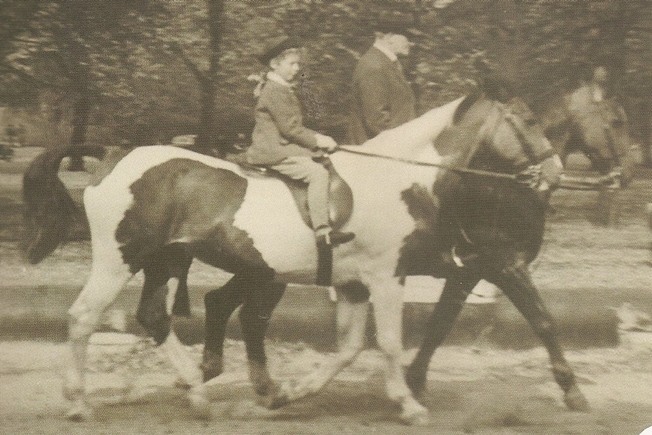
My interest in the working horses of London in the 1940s, when I was a child, led me to wanting to learn to ride. Before I could have my first lesson, I needed to have the right clothes. At the age of nine, I did not possess trousers and jeans were not worn. I always wore skirts or dresses. I was taken to the Harry Hall stores where suitable a tweed jacket and jodhpurs were put onto me. They were large in size in order to allow for growing and the legs of the bat-winged jodhpurs were profusely wrinkled. In order to check for correct fitting, I was allowed to sit on a life-sized model pony. This was a huge thrill. There was no question of a hard hat. I had a felt hat that was held in place with elastic under my chin and I was to wear my lace up outdoor shoes. Riding boots were not discussed.
It was fortunate that my first riding lesson was booked with Robert Barley at the Knightsbridge Riding School. He was one of London’s last job masters, who provided many working horses in the city. Bert, as he was known, and his instructress Dickie, had a tremendous influence in my life. If it had not been for them, I doubt if I would be writing this piece for the Carriage Commentator.
The mews stables were meant to accommodate six horses, in two loose boxes and four stalls. Bert housed eleven animals in the stables by dividing the loose boxes with swinging bales and squeezing ponies into every available space. He even had a large goat with huge horns in one corner so that in case of fire, she could be led out in the hope that the horses would follow her.
In the 1940s, in London, riding lessons happened in Rotten Row in Hyde Park. Bert rode a horse and I was taken on a pony on a leading rein. From Queen’s Gate Mews we went along Queen’s Gate to Hyde Park. There was a wide sandy track which went up to Hyde Park Corner and from there, was a road with a track which led to another which went on up to Marble Arch. I must have been told about the ‘up downs’ of trotting but I do not recall it causing me any worry.
The weekly riding lesson cost 12 shillings and sixpence (62p). I was kept on the leading rein for two years, much to my disgust. Because I kept asking to be let off the leading rein, my pleas were satisfied by my being put on bouncier ponies which I enjoyed, with ever growing confidence, never seeing any danger. I spent as much time as possible at the stables as I was able to cycle the five miles or so from Chiswick. This resulted in my becoming more involved with driving horses.
There was one occasion when a horse was needed for the next day’s deliveries at a large bakery. Bert harnessed a pony to a two-wheeled Dog Cart and took me with him so that I could help by leading the horse as it trotted along behind. On another occasion a man arrived with a Hackney pony and asked me to hold it while he went to the pub at the end of the mews. Luckily it stood quietly. One day Bert asked me to clean a set of team harness and I was told not to alter any of the buckles. He had got it all adjusted for a job the next day. I laid it out on the cobbles of the mews and did my best to tidy up the harness, so that it looked a bit cleaner, taking great care not to alter any of the straps.
The following day the team was put to the Road Coach, which stood outside in all weathers, ready for use with film work or any other commercial job. I was allowed to ride inside while Bert drove up and down a gravel road in Kensington so that sound engineers could record the noises of a four-in-hand being driven to an iron shod coach for future use in things like radio programmes. It must have been a very difficult job for Bert having to drive up and down the same piece of road and having to turn the team and coach in a tight space. I remember that the job went on for a long time before the engineers were happy with their recordings.
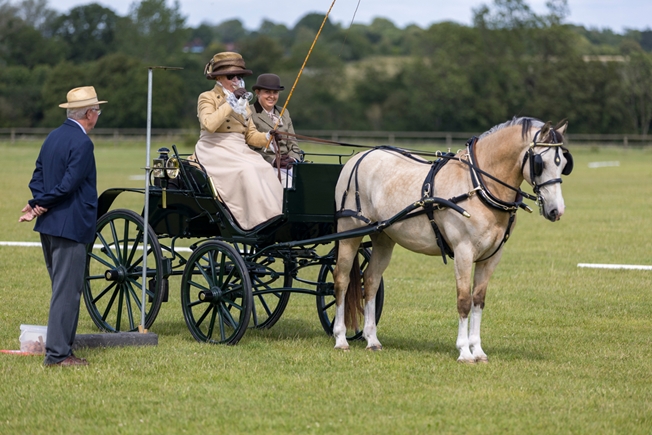
I was keen to learn how to drive properly because although I had driven the milkman’s horses, I realised that my rein handling was quite different from the way in which Bert held the reins. The milkman drove with a rein in each hand. Bert held all the reins in his left hand and he always carried a driving whip. I gave up one of my precious weekly riding lessons in order to have a driving lesson with Bert. A bay pony called Rosie was put to a varnished Governess Cart with a set of full collar brown harness. Bert showed me how to hold the reins in my left hand with my right hand supporting and I had a wonderful lesson along a quiet road in Hyde Park.
I remember feeling disappointed that he did not let me drive to or from the Park, but I watched how he drove so that I could do my best to do the same. I once saw a magnificent team of Friesians with black plumes on their heads pulling a funeral Hearse in Knightsbridge. They went out of fashion soon after this, being replaced by motorised versions. It is wonderful to know that there is now great demand for these turnouts. It is thanks to Sandy Watney and the formation of the British Driving Society in 1957 that the art of carriage driving did not become lost forever.